
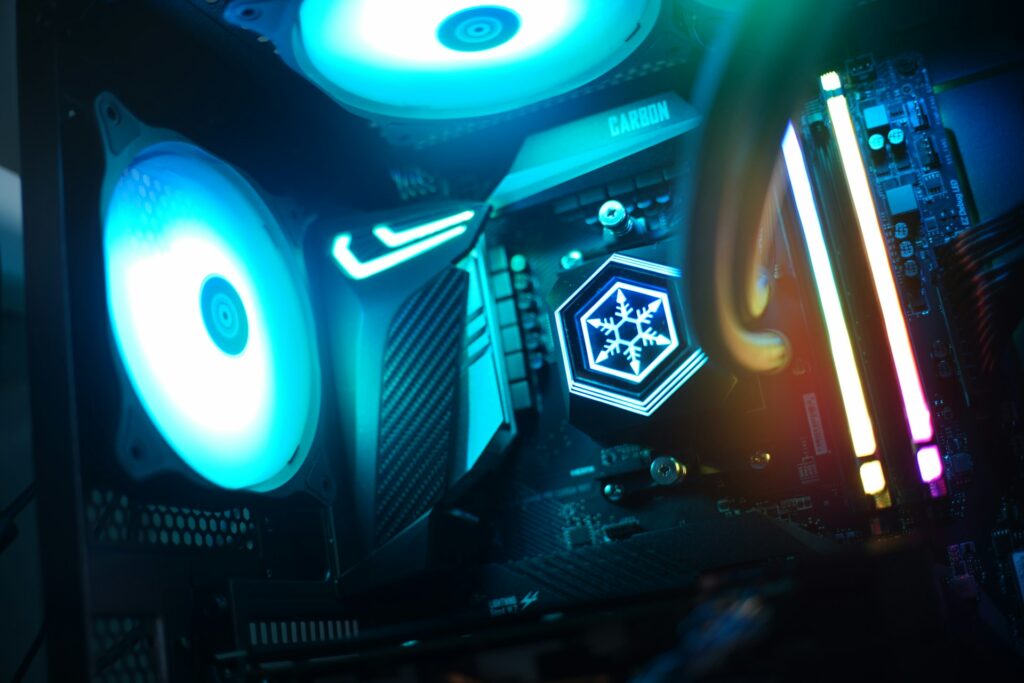
The debate between air and liquid cooling is one of the most enduring in PC building, often framed as a simple contest of peak performance. In reality, the choice represents a fundamental decision between two different engineering philosophies with distinct advantages, compromises, and ideal applications. Air cooling operates on the principle of direct conduction: heat from the CPU is transferred via thermal paste to a copper baseplate, then through heat pipes containing a working fluid to a stack of aluminum fins, where fans dissipate the heat into the case air. AIO liquid cooling, by contrast, uses an intermediate fluid: heat is transferred from the CPU to a water block, pumped through tubes to a radiator, where fans then expel the heat, creating a more distributed thermal management system. Understanding this core difference is key to evaluating which solution aligns with your build’s goals, whether that’s absolute silence, maximum overclocking headroom, or straightforward reliability.
When evaluating pure thermal performance in a high-wattage scenario, a premium 280mm or 360mm AIO cooler will generally outperform even the best dual-tower air coolers. This is because the liquid’s high specific heat capacity allows it to absorb a burst of thermal load more effectively, and the large radiator surface area provides superior heat dissipation potential. However, this performance lead is not absolute; for mainstream CPUs operating at stock or modestly boosted speeds, a high-quality air cooler like a dual-tower design with two fans will deliver temperatures that are virtually identical to a mid-range 240mm AIO in sustained workloads. The critical factor is often case airflow and ambient temperature; a well-ventilated case can allow a massive air cooler to rival liquid, while a restrictive case may cause an AIO to perform better by exporting heat directly out of the case via its radiator.
Beyond peak numbers, the characteristics of noise, reliability, and complexity tell a more nuanced story. A premium air cooler’s noise profile is typically defined by the fans alone, which can be swapped or tuned easily, and it offers fail-safe operation—if a fan dies, the massive passive heatsink still provides basic cooling. An AIO introduces additional points of potential failure: the pump, which has a finite lifespan and produces a low hum, and the fluid itself, which can permeate or evaporate over years. However, a high-quality AIO can often run quieter under moderate loads, as its radiator fans can spin slower while the pump manages heat transfer, and it eliminates the issue of turbulent air noise against a dense fin stack. The installation of an AIO is also more complex, involving mounting a radiator, pump block, and managing additional cables and tubes within your case.
The physical and aesthetic impact on your build cannot be overlooked. A large dual-tower air cooler is a dominating presence in your case, which can obstruct view of RGB RAM, make accessing the top PCIe slot difficult, and place significant weight and stress on the motherboard over time. An AIO, with its relatively compact pump block on the CPU, frees up visual and physical space around the socket, allowing for cleaner aesthetics and easier access to components. This makes AIOs particularly popular in builds focused on showcasing internal components. However, you must have compatible mounting locations for the radiator (typically at the top, front, or side of the case), and a thick radiator can interfere with tall RAM modules or VRM heatsinks when mounted at the top.
Making the final decision requires honest assessment of your needs. For a value-oriented build, a workhorse PC where reliability is paramount, or a compact case with limited radiator support, a high-quality air cooler is the unequivocal champion. For an enthusiast pushing the limits of an overclocked high-core-count CPU, a builder seeking the quietest possible system under variable loads, or anyone crafting a showcase build with specific aesthetic goals, a 280mm or 360mm AIO represents a justifiable investment. There is no universally “better” solution; there is only the right tool for the job. By weighing thermal performance against acoustic goals, reliability concerns, physical constraints, and budget, you can select a cooling solution that perfectly cools not just your processor, but also any anxieties about making the wrong choice.